MESA ANYTHING I/O DAUGHTER CARDS
DIN
RAIL CLIPS
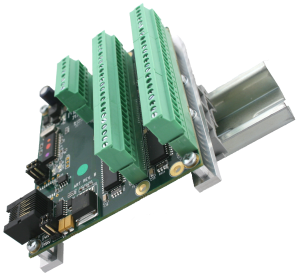
DIN rail mounting hardware is available
for all daughtercards with 3.7" hole spacing (this includes
almost all daughter cards except the THCAD). Hardware consists of a
pair of plastic DIN rail clips and aluminum mounting bar plus
3mm
threaded spacers and screws. DIN rail clips are sold in sets of 2.
COMMON
BLOCK
This common block is for
convenient removable screw terminal plug commoning of power and ground
connections. The common block uses standard spacing that matches most
other Mesa daughter cards. 24 terminals are
provided with each common blocksplit into 2 groups of 12 commoned pins.
3.5 mm pluggable screw terminal block are used for all connections.

50 PIN HEADER DAUGHTERCARDS
These daughtercards work with all
FPGA cards having 50 pin headers, including the 4I34M, 4I38 PC/104 FPGA
cards, the 4I65, 4I68, 4I69 PCI/104 FPGA cards, The 5I20, 5I22, 5I23,
5I24 PCI cards the 6I68/7I68 PCIE FPGA
cards, and the 7I43, 7I61 USB/parallel FPGA cards.
7I33/7I33TA Quad Analog servo
interface
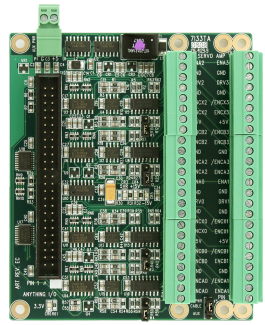
The 7I33, 7I33T
and 7I33TA are a 4 axis analog servo interfaces intended for
operation
with MESAs Anything I/O cards in motion control
applications. The 7I33 takes the PWM and direction signals from the
Anythng I/O card and converts them to +- 10V analog output voltages for
direct connection to analog input servo amplifiers. The
7I33
also conditions the encoder input signals with input filters for TTL
inputs or RS-422 recievers for differential encoder inputs.
The
controller connection is a 50 pin header that matches the pinout of
the Mesas Anything I/O
cards.
Another 50 pin header is used for servo amp/encoder
connections. The -TA version uses 3.5 mm
pluggable screw terminal plugs (included). (7I33TA shown)
7I34
Eight Channel RS-422/485
interface
The 7I34 is a 8
channel RS-422 interface for Mesa s Anything
I/O
series of FPGA interface cards. The 7I34 has 8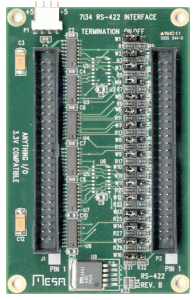 independent
receive and transmit channels. Each transmit channel has a independent
drive enable for bus or 2 wire half duplex systems. The
controller connection is a 50 pin header that matches the pinout or the
4I34M, 4I38, 4I65, 4I68, 5I20, 5I22, 5I23, 7I43 and 7I60 Anything
I/O cards.
Another 50 pin header is used for RS-422
connections. The
7I34 has an assembly option for receive only applications. This model
(7I34-R) has 16 RS-422 inputs but no outputs .Another assembly option
(7I34-485) replaces the drivers with RS-485 compatible chips. The
7I34 can be used with an Anything I/O card for multiple
channel RS-422
serial interfaces, encoder interfaces, and many other industrial
applications.
independent
receive and transmit channels. Each transmit channel has a independent
drive enable for bus or 2 wire half duplex systems. The
controller connection is a 50 pin header that matches the pinout or the
4I34M, 4I38, 4I65, 4I68, 5I20, 5I22, 5I23, 7I43 and 7I60 Anything
I/O cards.
Another 50 pin header is used for RS-422
connections. The
7I34 has an assembly option for receive only applications. This model
(7I34-R) has 16 RS-422 inputs but no outputs .Another assembly option
(7I34-485) replaces the drivers with RS-485 compatible chips. The
7I34 can be used with an Anything I/O card for multiple
channel RS-422
serial interfaces, encoder interfaces, and many other industrial
applications.
7I37/7I37TA Isolated I/O card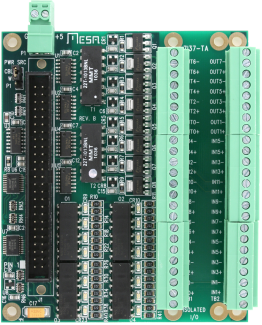
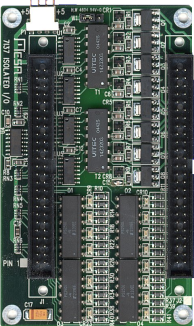
The 7I37 is an 8
output, 16 input isolated I/O card. The 7I37
provides 8 Isolated 48VDC 1A output drivers. All output drivers are low
saturation voltage MOSFETS for low power dissipation. Each of the 8
output switches is isolated from the others, allowing high side, low
side, push-pull and other output switch configurations. The 16 opto
isolated inputs will operate with input voltages from 5 to 24 V.
Reverse protection diodes are provided to allow use with AC inputs. The
7I37 is compatible with the 4I24M, 4I24H, and all 50 pin
connector Anything I/O cards. The plain 7I37 has a
50 pin header for I/O, The -TA version includes 3.5mm pluggable screw
terminals.
7I37COM Isolated I/O card
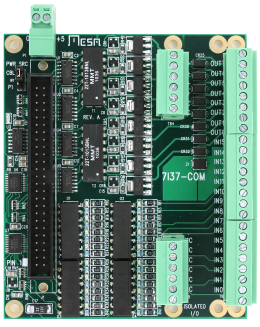
The 7I37COM is a
version of the 7I37 with a common input reference and a common
output power source. The 7I37COM can simplify I/O wiring when
individually
isolated inputs and outputs are not required. The 7I37COM has 16
isolated inputs and 8 isolated outputs like the standard 7I37 but the
inputs share a common ground or minus input reference, and the outputs
share a common power source. The outputs drive ground referred loads
(so call PNP output type).
The 7I37COMs I/O specifications are the same as the standard 7I37 but
the 7I37COM adds output freewheeling diodes. Due to the output power
commoning, AC loads cannot be driven b y th e 7I37COM.
7I42/7I42TA
Breakout/FPGA
protection card
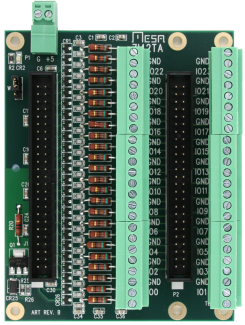 The 7I42 is a breakout card for Mesa's 50 pin I/O FPGA cards.
It is available with 50 pin .1" output connector (7I42) or 3.5mm
headers compatible with pluggable screw terminal blocks (7I42T and
7I42TA). In
addition to providing a breakout function, the 7I42 protects the FPGA
card from excessive input voltages and ESD. The 7I42 protects FPGA I/O
from accidental contact from external voltages of +12 and -5V with
built in diode clamps and 50 Ohm current limit resistors in series with
all I/O pins. The 7I42 limits I/O pin bandwidth to approximately 10 MHz.
Phoenix compatible 3.5 mm pluggable screw terminals are supplied with
the 7I42TA
The 7I42 is a breakout card for Mesa's 50 pin I/O FPGA cards.
It is available with 50 pin .1" output connector (7I42) or 3.5mm
headers compatible with pluggable screw terminal blocks (7I42T and
7I42TA). In
addition to providing a breakout function, the 7I42 protects the FPGA
card from excessive input voltages and ESD. The 7I42 protects FPGA I/O
from accidental contact from external voltages of +12 and -5V with
built in diode clamps and 50 Ohm current limit resistors in series with
all I/O pins. The 7I42 limits I/O pin bandwidth to approximately 10 MHz.
Phoenix compatible 3.5 mm pluggable screw terminals are supplied with
the 7I42TA
7I42
MANUAL
7I44 Eight Channel RS-422/485
interface/ RJ45 Breakout
The 7I44 is a 8
channel RS-422 interface for Mesa s Anything
I/O
series of FPGA interface cards. The 7I44 has 8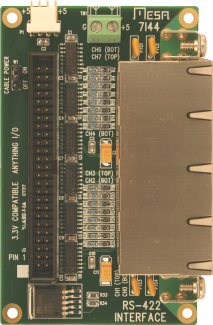 independent
receive and transmit channels. Each transmit channel has a independent
drive enable for bus or 2 wire half duplex systems. Serial
I/O connectors are RJ45 jacks allowing standard CAT5
cables to be used for high speed serial links. The 7I44
also supplies 5V power on the RJ 45 connectors. PTC
devices limit maximum 5V current to 1A . The pinout used is compatible
with Mesa's 3C20 motion controller and the 8I20, 8I21 serially
connected amplifiers and all serially interfaced I/O cards.
independent
receive and transmit channels. Each transmit channel has a independent
drive enable for bus or 2 wire half duplex systems. Serial
I/O connectors are RJ45 jacks allowing standard CAT5
cables to be used for high speed serial links. The 7I44
also supplies 5V power on the RJ 45 connectors. PTC
devices limit maximum 5V current to 1A . The pinout used is compatible
with Mesa's 3C20 motion controller and the 8I20, 8I21 serially
connected amplifiers and all serially interfaced I/O cards.
7I44
MANUAL
7I46 six Channel SPI breakout card
The 7I46 is a
six channel
SPI breakout. It connects the 50 pin Anything I/O cable to six 10
conductor SPI cables. The 7I46 also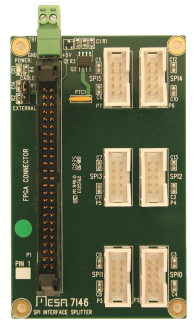 supplies 5V power to remote SPI
devices via the 10 conductor cables. Total power is limited to 3A. A
built-in high side power switch disconnects SPI power when cable power
is removed, preventing back
powering the FPGA card when the PC is powered down.
supplies 5V power to remote SPI
devices via the 10 conductor cables. Total power is limited to 3A. A
built-in high side power switch disconnects SPI power when cable power
is removed, preventing back
powering the FPGA card when the PC is powered down.
7I46
MANUAL
7I47 12 Channel motion oriented
RS-422
interface
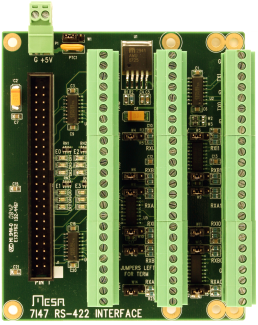 The 7I47 is a 12 channel
RS-422 interface for Mesa s Anything
I/O
series of FPGA interface cards. The 7I47 is designed for motion control
applications, both for buffering FPGA outputs and for conditioning
RS-422 inputs. A common usage of the 7I47 would be connecting up to 6
step+direction step drives to the 7I47s RS-422 outputs and up to 6
encoders (4 with index) to the 7I47's RS-422 inputs. The RS-422 outputs
can be used as single ended outputs for driving ground or +5V
referenced loads. When used as single ended outputs, the 7I47 outputs
swing from 0 to 5V and will sink or source 20mA. 12 LEDS monitor
encoder input status. The 7I47 can also supply 5V
power to encoders. The
controller connection is a 50 pin header that matches the pinout of
Mesa'a Anything
I/O cards. All buffered I/O is terminated with 3.5 mm pluggable
screw terminals (supplied)
The 7I47 is a 12 channel
RS-422 interface for Mesa s Anything
I/O
series of FPGA interface cards. The 7I47 is designed for motion control
applications, both for buffering FPGA outputs and for conditioning
RS-422 inputs. A common usage of the 7I47 would be connecting up to 6
step+direction step drives to the 7I47s RS-422 outputs and up to 6
encoders (4 with index) to the 7I47's RS-422 inputs. The RS-422 outputs
can be used as single ended outputs for driving ground or +5V
referenced loads. When used as single ended outputs, the 7I47 outputs
swing from 0 to 5V and will sink or source 20mA. 12 LEDS monitor
encoder input status. The 7I47 can also supply 5V
power to encoders. The
controller connection is a 50 pin header that matches the pinout of
Mesa'a Anything
I/O cards. All buffered I/O is terminated with 3.5 mm pluggable
screw terminals (supplied)
7I47
MANUAL
7I47S 8/12 Channel motion
oriented RS-422
interface with analog out
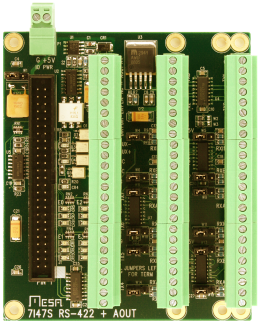 The
7I47S is a 12 input, 8 output
RS-422 interface for Mesa s Anything
I/O
series of FPGA interface cards. The 7I47S is designed for motion
control
applications, both for buffering FPGA outputs and for conditioning
RS-422 inputs. In addition the 7I47S has an isolated potentiometer type
analog output. This analog output can be used for spindle speed control
applications. Three opto isolated outputs are also available. One is
intended for direction, one for enable, and one for general
purpose use. The RS-422 outputs
can be used as single ended outputs for driving ground or +5V
referenced loads. When used as single ended outputs, the 7I47 outputs
swing from 0 to 5V and will sink or source 20mA. 12 LEDS monitor
encoder input status. The 7I47 can also supply 5V
power to encoders. The analog output range is
determined by the user supplied analog reference. The analog output
reference can be from 5 to 15 VDC. The
controller connection is a 50 pin header that matches the pinout of
Mesa'a Anything
I/O cards. All buffered I/O is terminated with 3.5 mm pluggable
screw terminals (supplied)
The
7I47S is a 12 input, 8 output
RS-422 interface for Mesa s Anything
I/O
series of FPGA interface cards. The 7I47S is designed for motion
control
applications, both for buffering FPGA outputs and for conditioning
RS-422 inputs. In addition the 7I47S has an isolated potentiometer type
analog output. This analog output can be used for spindle speed control
applications. Three opto isolated outputs are also available. One is
intended for direction, one for enable, and one for general
purpose use. The RS-422 outputs
can be used as single ended outputs for driving ground or +5V
referenced loads. When used as single ended outputs, the 7I47 outputs
swing from 0 to 5V and will sink or source 20mA. 12 LEDS monitor
encoder input status. The 7I47 can also supply 5V
power to encoders. The analog output range is
determined by the user supplied analog reference. The analog output
reference can be from 5 to 15 VDC. The
controller connection is a 50 pin header that matches the pinout of
Mesa'a Anything
I/O cards. All buffered I/O is terminated with 3.5 mm pluggable
screw terminals (supplied)
7I47S
MANUAL
7I48 6 channel Analog servo
interface
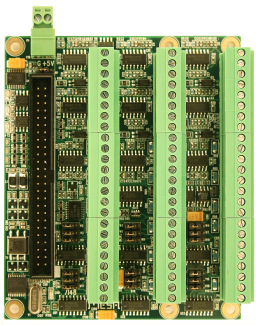 The 7I48 is a 6 axis analog servo interface intended for
operation
with MESAs Anything I/O cards in motion control
applications. The 7I48 takes complementary PWM signals from the
Anythng I/O card and converts them to +- 10V analog output voltages for
direct connection to analog input servo amplifiers. The 7I48 has 5 pole
filters on each analog channel to eliminate output ripple at PWM
frequencies down to 24 KHz. The
7I48
also conditions the encoder input signals for TTL or RS-422
encoder inputs.
The
controller connection is a 50 pin header that matches the pinout of
the Anything I/O
cards. All analog and encoder I/O is terminated with pluggable 3.5 mm
screw terminals (supplied).
The 7I48 is a 6 axis analog servo interface intended for
operation
with MESAs Anything I/O cards in motion control
applications. The 7I48 takes complementary PWM signals from the
Anythng I/O card and converts them to +- 10V analog output voltages for
direct connection to analog input servo amplifiers. The 7I48 has 5 pole
filters on each analog channel to eliminate output ripple at PWM
frequencies down to 24 KHz. The
7I48
also conditions the encoder input signals for TTL or RS-422
encoder inputs.
The
controller connection is a 50 pin header that matches the pinout of
the Anything I/O
cards. All analog and encoder I/O is terminated with pluggable 3.5 mm
screw terminals (supplied).
7I49 6 channel resolver interface
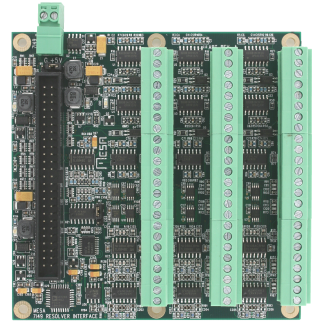 The 7I49 is a 6 channel resolver interface with 6 additional +-10V
analog outputs. The 7I49 is intended for applications that read
standalone resolvers, as the 7I49 generates the resolver reference
excitation. The 7I49 can be used with 1:1 and 1:2 transformation ratio
resolvers. The 7I49 has approximately 14 bits of resolution
and 12 bits of absolute accuracy, The 7I49 FPGA interface
module allows velocity and absolute position readout from
the host. The 7I49 has selectable excitation frequencies, from
2.5 KHz up to 10 KHz. Host
position readout is updated at 256 times the excitation frequency to
reduce aliasing when host sampling is not synchronous with the
excitation frequency. Velocity resolution is approximately 1 RPM. The
7I49 uses a oversampling A-D followed by a tracking filter. Filter
coefficients may be changed to trade off noise versus acceleration
tracking ability. All resolver and analog I/O is via 3.5 MM pluggable
screw terminal blocks. The 7I49 requires a single 5V power supply.
The 7I49 is a 6 channel resolver interface with 6 additional +-10V
analog outputs. The 7I49 is intended for applications that read
standalone resolvers, as the 7I49 generates the resolver reference
excitation. The 7I49 can be used with 1:1 and 1:2 transformation ratio
resolvers. The 7I49 has approximately 14 bits of resolution
and 12 bits of absolute accuracy, The 7I49 FPGA interface
module allows velocity and absolute position readout from
the host. The 7I49 has selectable excitation frequencies, from
2.5 KHz up to 10 KHz. Host
position readout is updated at 256 times the excitation frequency to
reduce aliasing when host sampling is not synchronous with the
excitation frequency. Velocity resolution is approximately 1 RPM. The
7I49 uses a oversampling A-D followed by a tracking filter. Filter
coefficients may be changed to trade off noise versus acceleration
tracking ability. All resolver and analog I/O is via 3.5 MM pluggable
screw terminal blocks. The 7I49 requires a single 5V power supply.
7I49
MANUAL
7I50 SPI I/O expander
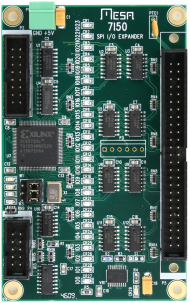 The 7I50 is a 24 I/O SPI expander for use with
MESAs Anything I/O cards. The 7I50 has 24 bidirectional logic
level I/O pins and connects to a SPI interface. The 7I50
can use a TTL level SPI interface or differential SPI. One Anything I/O
connector can drive six 7I50s for a total of 144 I/O points per FPGA
card connector (the 7I46 SPI breakout is a convenient way to wire
multiple 7I50s). SPI data rates up to 8 MHz are supported
allowing a 4 uSec update cycle. The 7I50s I/O connector is a 50 pin
header that matches the pinout of the Anything I/O card and is OPTO22
compatible. I/O pins are open drain and will swing to 5V.Outputs
will sink 15 mA. A buiilt in watchdog sets all outputs to the inactive
state if the 7I50 is not accessed with the proper code with in a
selectable timeout interval. I/O status LEDs are provided for all
24 I/O bits, and SPI link status LEDs monitor SPI connection
integrity.
The 7I50 is a 24 I/O SPI expander for use with
MESAs Anything I/O cards. The 7I50 has 24 bidirectional logic
level I/O pins and connects to a SPI interface. The 7I50
can use a TTL level SPI interface or differential SPI. One Anything I/O
connector can drive six 7I50s for a total of 144 I/O points per FPGA
card connector (the 7I46 SPI breakout is a convenient way to wire
multiple 7I50s). SPI data rates up to 8 MHz are supported
allowing a 4 uSec update cycle. The 7I50s I/O connector is a 50 pin
header that matches the pinout of the Anything I/O card and is OPTO22
compatible. I/O pins are open drain and will swing to 5V.Outputs
will sink 15 mA. A buiilt in watchdog sets all outputs to the inactive
state if the 7I50 is not accessed with the proper code with in a
selectable timeout interval. I/O status LEDs are provided for all
24 I/O bits, and SPI link status LEDs monitor SPI connection
integrity.
7I50
MANUAL
7I52 6 Channel encoder 6 channel
Serial RS-422
interface
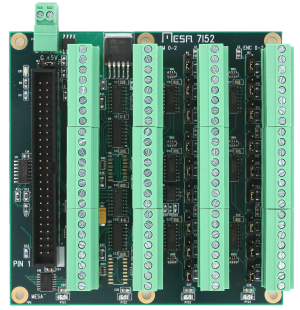 The
7I52 is a six channel
RS-422 serial plus six channel encoder interface for Mesas Anything
I/O
series of FPGA interface cards. The 7I52 is designed for motion control
applications. A common usage of the 7I52 would be connecting up to six
serially interfaced drives to the 7I52s six full duplex RS-422
interfaces and up to six
encoders with index to the 7I52s encoder inputs. Two of the 7I52s
serial links support RS-485. Encoder inputs can be TTL or differential
on a per input basis. The 7I52 can also supply 5V
power to encoders. A 7I52S version is available that
replaces the six serial interfaces with 12 differential ouputs that can
be used as six differential step+ dir output pairs or PWM outputs
or other output functions. The
controller connection is a 50 pin header that matches the pinout of
Mesa's Anything
I/O cards. All buffered I/O is terminated with 3.5 mm pluggable
screw terminals (supplied)
The
7I52 is a six channel
RS-422 serial plus six channel encoder interface for Mesas Anything
I/O
series of FPGA interface cards. The 7I52 is designed for motion control
applications. A common usage of the 7I52 would be connecting up to six
serially interfaced drives to the 7I52s six full duplex RS-422
interfaces and up to six
encoders with index to the 7I52s encoder inputs. Two of the 7I52s
serial links support RS-485. Encoder inputs can be TTL or differential
on a per input basis. The 7I52 can also supply 5V
power to encoders. A 7I52S version is available that
replaces the six serial interfaces with 12 differential ouputs that can
be used as six differential step+ dir output pairs or PWM outputs
or other output functions. The
controller connection is a 50 pin header that matches the pinout of
Mesa's Anything
I/O cards. All buffered I/O is terminated with 3.5 mm pluggable
screw terminals (supplied)
7I52
MANUAL 7I52S
MANUAL
7I53 12 Channel encoder 2 channel
Serial RS-422
interface
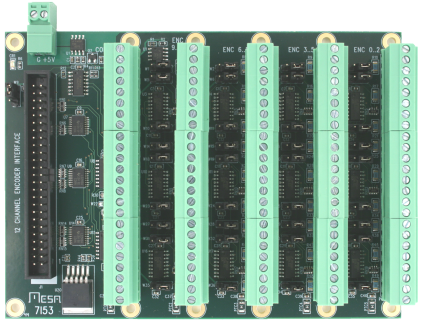 The
7I53 is a twelve channel encoder interface plus two channel RS-422
interface for Mesas Anything
I/O
series of FPGA interface cards. The 7I53 is designed for motion control
and measurement applications. One of the 7I53s
serial links support RS-485 operation. Encoder inputs can be TTL or
differential
on a per input basis. The 7I53 can also supply 5V
power to encoders. The
controller connection is a 50 pin header that matches the pinout of
Mesa's Anything
I/O cards. All buffered I/O is terminated with 3.5 mm pluggable
screw terminals (supplied)
The
7I53 is a twelve channel encoder interface plus two channel RS-422
interface for Mesas Anything
I/O
series of FPGA interface cards. The 7I53 is designed for motion control
and measurement applications. One of the 7I53s
serial links support RS-485 operation. Encoder inputs can be TTL or
differential
on a per input basis. The 7I53 can also supply 5V
power to encoders. The
controller connection is a 50 pin header that matches the pinout of
Mesa's Anything
I/O cards. All buffered I/O is terminated with 3.5 mm pluggable
screw terminals (supplied)
7I53
MANUAL
7I65
Octal Analog servo
interface
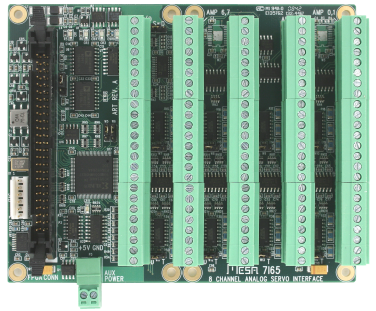 The 7I65 is a eight
axis analog servo interface intended for
operation
with MESAs Anything I/O cards in motion control
applications. The 7I65 has eight 16 bit DAC channels and eight TTL or
differential encoder
inputs. In addition the 7I65 has eight 12 bit + sign A-D inputs,
eight isolated motor enable outputs and four isolated digital inputs.
Analog outputs have software selectable ranges that include -10V to
+10V, -5V to +5V, 0V to +5V and 0V to +10V. Analog inputs also have
software selectable ranges including -10V to +10V, -5V to +5V, -2.5V to
+2.5V and 0V to +5V. Input and output ranges can be selected on a
channel by channel basis. All 7I65 Analog I/O is galvanically isolated
from system logic ground to prevent ground loops and digital noise from
interfering with the analog signals. A built in watchdog timer
sets the analog outputs to 0V if the 7I65 has not been accessed within
the settable watchdog timer interval. An on card EEPROM allows analog
gain and offset values to be stored fo software controlled calibration.
The
7I65 conditions the encoder input signals with input filters for
TTL
inputs or RS-422 recievers for differential encoder inputs. The
controller connection is a 50 pin header that matches the pin-out of
the
Anything I/O
cards. 3.5 mm screw terminal compatible plugs are used for
motor and misc I/O. All pluggable screw terminal blocks are included
with the 7I65.
The 7I65 is a eight
axis analog servo interface intended for
operation
with MESAs Anything I/O cards in motion control
applications. The 7I65 has eight 16 bit DAC channels and eight TTL or
differential encoder
inputs. In addition the 7I65 has eight 12 bit + sign A-D inputs,
eight isolated motor enable outputs and four isolated digital inputs.
Analog outputs have software selectable ranges that include -10V to
+10V, -5V to +5V, 0V to +5V and 0V to +10V. Analog inputs also have
software selectable ranges including -10V to +10V, -5V to +5V, -2.5V to
+2.5V and 0V to +5V. Input and output ranges can be selected on a
channel by channel basis. All 7I65 Analog I/O is galvanically isolated
from system logic ground to prevent ground loops and digital noise from
interfering with the analog signals. A built in watchdog timer
sets the analog outputs to 0V if the 7I65 has not been accessed within
the settable watchdog timer interval. An on card EEPROM allows analog
gain and offset values to be stored fo software controlled calibration.
The
7I65 conditions the encoder input signals with input filters for
TTL
inputs or RS-422 recievers for differential encoder inputs. The
controller connection is a 50 pin header that matches the pin-out of
the
Anything I/O
cards. 3.5 mm screw terminal compatible plugs are used for
motor and misc I/O. All pluggable screw terminal blocks are included
with the 7I65.
7I65
MANUAL
REMOTE
SERIAL DAUGHTERCARDS
These daughtercards use a robust RS-422 high speed serial link
to simplify wiring. FPGA firmware
hides the protocol details to allow simple real time access to multiple
remote serial I/O points or analog I/O. These cards support real time
operation with from 5 to 10 KHz update rates of all remote data, and
expandability to more than 1000 I/O points. All serial daughtercards
require a RS-422 interface daughtercard (or native RS-422 FPGA
card) at the host FPGA end. Suitable daughtercards include the 7I44,
7I47, 7I52, 7I53 (50 pin daughtercard type) and the 7I74, 7I76, 7I77,
7I78, 7I85 (DB 25 daughtercard type) Compatible native RS-422 interfaced FPGA cards include the 5I21 and the 4I74.
Version 14 serial remote I/O card firmware
This is the latest firmware
for the sserial daughtercards. This firmware contains enhancements,
added modes and important bug fixes. All serial daughtercards with
firmware earlier than R14 and 8I20 firmware earlier than R11 should be updated. This firmware set is for
all serial remote I/O cards except the 7I64. This firmware
also applies to the 7I76 and 7I77.
R14
FIRMWARE and SSERIAL UTILITIES
7I64
Isolated remote I/O card
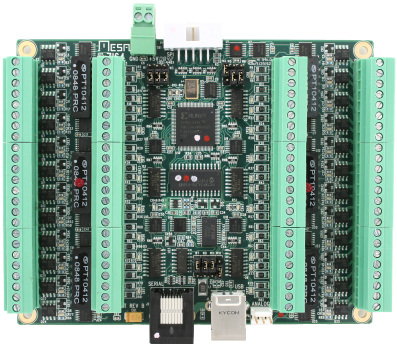
The
7I64 is an 24 output, 24 input isolated I/O card. The 7I64
provides 24 isolated 48VDC 2.5A output drivers. All output drivers are
low
saturation voltage MOSFETS for low power dissipation. Each of the 24
output switches is isolated from the others, allowing high side, low
side, push-pull and other output switch configurations. A built in
watchdog timer turns all outputs off if the 7I64 is not accessed within
a selectable watchdog timeout interval. The 24 opto isolated inputs
will operate with input voltages from 5 to 24 V.
Reverse protection diodes are provided to allow use with AC inputs.
The 7I64 has three host interface methods, USB, Serial RS-422 and
SPI. The 7I64 can be USB powered. The serial interface supports baud
rates from 115.2 K baud to 2.5 M baud. The SPI interface is compatible
with MESAs
Anything I/O cards and support high speed real time I/O.
A SPI breakout card (7I46) allows up to six 7I64s to connect to a
single 50 pin Anything I/O connector. The
SPI interface supports data rates to 8 Mbps so a full read/write of
all 48 I/O bits takes approximately 4 uSec. The RS-422 interface at 2.5
MBaud is compatible with HostMot2s SSLBP smart serial interface which
can support as many as 32 7I64 cards for a total of 1536 I/O points
with real time update rates up to 5 KHz.
3.5 mm screw pluggable screw terminals are used for all isolated
I/O.
7I64
MANUAL
7I66
Isolated remote digital input and power driver card
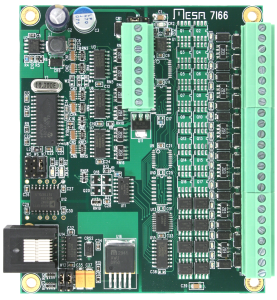
The
7I66 is a remote isolated digital I/O card. The 7I66 is available in
two models, the 7I66-8 (8 output and 16 input) and 7I66-24 (24 output).
The 7I66 inputs sense positive
inputs relative to a common field ground. Input impedance is 22K Ohms
and inputs can range from 5VDC to 32VDC.
All I/O pins have LED status indicators. Outputs are sourcing type
drivers capable of driving 2.5 A loads. The field I/O points are are
galvanically isolated from the communications link. The 7I66 uses field
power of 8VDC to 32VDC and sets its default input threshhold to 50% of
field power supply voltage with 10% hysteresis. Inputs can be
programmed to other thresholds and filtering can be added if desired.
In addition to the being able to read digital on/off status of each
input, all input pin voltages are readable with 8 bit resolution
(7I66-8 only). The
RS-422 interface at 2.5M Baud is compatible with HostMot2s SSLBP smart
serial interface which
can support as many as 32 7I66 cards with
real time update rates up to 10 KHz and cable lengths up to 100
feet. 3.5 mm screw pluggable screw terminals are used for all
isolated I/O.
7I66
MANUAL
7I69 remote digital I/O card
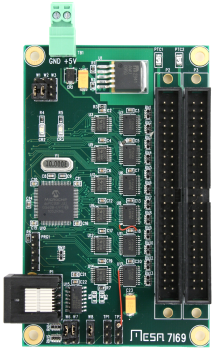
The
7I69 is a remote digital I/O card with 48 digital I/O bits. All I/O
bits are 5V TTL compatible open collector type drivers with 15 mA sink
capability per I/O pin. When output pins are set high, they may
be used as inputs. Each I/O pin has a 3.3K pullup for direct connection
with switches, optosensors etc. I/O connectors are 50 pin headers with
I/O module rack compatible pinouts. The pinout and drive capabilities
make the 7I69 compatible with Opto22 I/O module racks. The pinout is
also compatible with Mesas standard FPGA daughter cards allowing the
7I69 to drive up to 2 simple isolator daugter cards like the 7I37. A
MPG option uses 8 input pins to provide high speed encoder
counting. The
RS-422 interface at 2.5M Baud is compatible with HostMot2s SSLBP smart
serial interface which
can support as many as 32 7I69 cards for a total of 1536 I/O bits with
real time update rates up to 10 KHz and cable lengths up to 100 feet.
7I69
MANUAL
7I70
Isolated remote digital input card
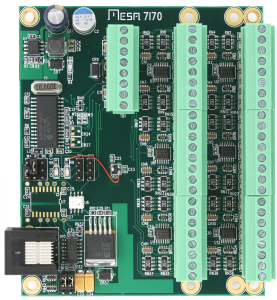
The
7I70 is a remote isolated 48 input card. The 7I70 inputs sense positive
inputs relative to a common field ground. Input impedance is 10K Ohms
and input voltage can range from 5VDC to 32VDC.
All inputs have LED status indicators. The input common field ground is
galvanically isolated from the communications link. The 7I70 uses field
power of 5VDC to 32VDC and sets its default input threshhold to 50% of
field power supply voltage with 10% hysteresis for noise immunity.
Inputs can be
programmed to other thresholds and filtering can be added if desired.
In addition to the being able to read digital on/off status of each
input, all input pin voltages are readable with 8 bit resolution. The
RS-422 interface at 2.5
MBaud is compatible with HostMot2s SSLBP smart serial interface which
can support as many as 32 7I70 cards for a total of 1536 inputs with
real time update rates up to 10 KHz. 3.5 mm screw pluggable screw
terminals are used for all isolated I/O.
7I70
MANUAL
7I71
Isolated remote power driver card
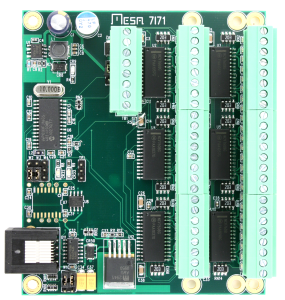
The
7I71 is a remote isolated 48 output card. The 48 outputs are 5VDC to
28VDC sourcing drivers (common + field power) with 300 mA maximum
current capability. All outputs have LED status indicators. Outputs
have per output short circuit protection, overvoltage clamps and per
driver chip thermal shutdown. The 7I71s outputs are suitable for
driving relays, contactors, solenoids, and other medium power inductive
or resistive loads. The outputs and field power are
galvanically isolated from the communications link. The
RS-422 interface at 2.5
MBaud is compatible with HostMot2s SSLBP smart serial interface which
can support as many as 32 7I71 cards for a total of 1536 outputs with
real time update rates up to 10 KHz. 3.5 mm screw pluggable screw
terminals are used for all isolated I/O.
7I71
MANUAL
7I72 Isolated remote power driver card
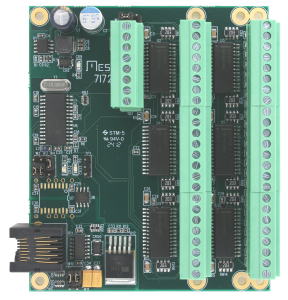
The
7I72 is identical to the 7I71 except that is uses sinking type drivers.
All other specifications are the same
7I72 MANUAL
7I73
Pendant/control panel interface
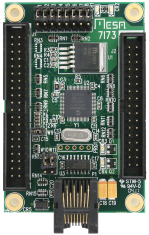
The
7I73 is a remote real time pendant or control panel interface. The 7I73
uses a high speed real time RS-422 link for host communications and can
support update rates up to 10K updates per second so there is no
detectable delay or roughness in the control panel or pendant
interface. The 7I73 supports up to four 50KHz encoder inputs for
MPGs, 8 digital inputs and 6 digital outputs and up to a 64 Key keypad.
If a smaller keypad is used, more digital inputs and outputs
become available. Up to eight 0.0V to 3.3V analog inputs are also
provided. The 7I73 can drive a 4 line 20 character LCD
for local DRO applications. Software contrast control is provided for
the LCD. The 7I73 is powered by the same CAT6 cable that provides the
data interface. Cable length can be up to 30 Meters. The
RS-422 interface at 2.5
MBaud is compatible with HostMot2s SSLBP smart serial interface.
7I73
MANUAL
7I83 Analog
output/ analog servo interface
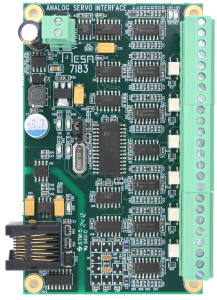
The 7I83 is remote isolated six
channel +-10V analog output card intended for analog drive interfacing
or other +-10V analog output applications. The analog
outputs, drive enables and field power are
galvanically isolated from the communications link. Analog outputs have
13 bit resolution and a 2.5 KHz bandwidth. In addition the six analog
channels, the 7I83 has six isolated optocoupler outputs intended for
individual drive enables The enable outputs are rated 50 mA and up to
100V. The 7I83 is powered by a single 8-35V power supply. The
RS-422 interface at 2.5
MBaud is compatible with HostMot2s SSLBP smart serial interface which
can support as many as 32 7I83 cards for a total of 192 analog outputs
with
real time update rates up to 10 KHz. 3.5 mm screw pluggable screw
terminals are used for all isolated I/O.
7I83
MANUAL
7I84
Isolated remote field I/O card
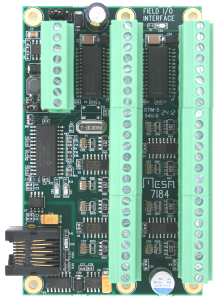
The
7I84 is a remote isolated 32 input and 16 output digital I/O card. The
16 outputs are 5VDC to
28VDC sourcing drivers with 300 mA maximum
current capability. Outputs
have per output short circuit protection, overvoltage clamps and per
driver chip thermal shutdown. The 7I84s outputs are suitable for
driving relays, contactors, solenoids, and other medium power inductive
or resistive loads. The 7I84 uses field
power of 5VDC to 28VDC and sets its default input threshhold to 50% of
field power supply voltage with 10% hysteresis for noise immunity.
Inputs can be
programmed to other thresholds and filtering can be added if desired.
In addition to the being able to read digital on/off status of each
input, four input pin voltages are readable with 8 bit
resolution. Two MPG encoder inputs are provided as an option on
four field inputs. Field
voltage can be split so that each half of the 7I84 uses a different
voltage source for the outputs and reference voltage for the inputs,
allowing mixed voltage I/O support. The inputs, outputs, and field
power are
galvanically isolated from the communications link. The
RS-422 interface at 2.5
MBaud is compatible with HostMot2s SSLBP smart serial interface which
can support as many as 32 7I84 cards for a total of 1024 inputs and 512
outputs with
real time update rates up to 10 KHz. 3.5 mm screw pluggable screw
terminals are used for all isolated I/O.
7I84
MANUAL
7I87 Remote isolated Analog input card
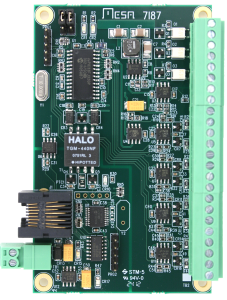
The 7I87 is remote isolated eight
channel +-10V analog input card. All channels have 12 bit
resolution and selectable averaging. All inputs are galvanically
isolated from the communication and remote power. A buffered A-D
reference voltage is provided for ratiometric applications. All
inputs have 100K input impedance (+-.1%) and are protected from input
overloads of up to 100V. Three optocoupler outputs are available.
The
RS-422 interface at 2.5
MBaud is compatible with HostMot2s SSLBP smart serial interface which
can support as many as 32 7I87 cards for a total of 256 analog inputs
with
real time update rates up to 10 KHz. 3.5 mm screw pluggable screw
terminals are used for all isolated I/O.
7I87
MANUAL
7IA0 Isolated remote I/O card
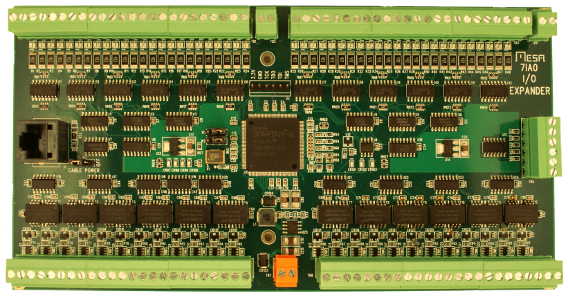
The 7IA0 is a 48 input, 24 output isolated I/O card. The
7IA0 provides 24 isolated 36VDC 2.5A output drivers and 48 isolated
inputs. All output drivers are low saturation voltage MOSFETs for low
power dissipation. Each of the 24 output switches is isolated from the
others, allowing high side, low side, push-pull and other output switch
configurations. A built in watchdog timer turns all outputs off if the
7IA0 is not accessed within the watchdog timeout interval The 48
isolated inputs operate with 4V to 36V DC and can have a positive or
negative common for sourcing or sinking input applications. 4 input
commons are provided for mixed sourcing/sinking/voltage compatibility.
All isolated input and outputs have LED status indicators. Eight of the
isolated input pins can be used to support up to four quadrature output
MPGs. Both 1x and 4x modes are selectable. Four eight bit analog inputs
are provided. The RS-422 interface at 2.5 MBaud is compatible with
HostMot2s SSLBP smart serial interface which can support as many as 32
7IA0 cards for a total of 2304 I/O points with real time update rates
up to 10 KHz.
3.5 mm pluggable screw terminals are used for all isolated I/O.
The 7IA0 can be cable powered or powered from a local 8VDC to 32VDC
supply. The 7IA0 mounts in a standard 107mm DIN tray which is available
from Mesa.
7IA0
MANUAL
DB25
DAUGHTERCARDS
These daughtercards work with the
5I25, 5I26 PCI FPGA cards, 6I25, 6I26 PCIE FPGA cards and the
7I80DB Ethernet FPGA card. These daughtercards can also be used with 50
pin FPGA cards with a cable adapter (HDDBADPT)
HD-DB ADAPTER
The HD-DB is an adapter that allows the use of 25 pin daughterc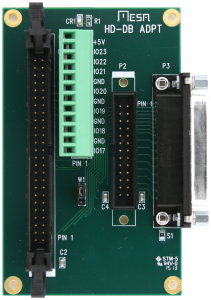 ards
with 50 pin FPGA cards. For example the HD-DB will allow the use of a
7I77 with a 5I20, 5I22, or 5I23 etc FPGA card. The 7 unused FPGA I/O pins are brought out to a terminal block for easy access.
ards
with 50 pin FPGA cards. For example the HD-DB will allow the use of a
7I77 with a 5I20, 5I22, or 5I23 etc FPGA card. The 7 unused FPGA I/O pins are brought out to a terminal block for easy access.
7I74
Eight Channel RS-422/485
interface/ RJ45 Breakout
The 7I74 is a 8
channel RS-422 interface for Mesa's 25 pin I/O FPGA
cards. The 7I74 has 8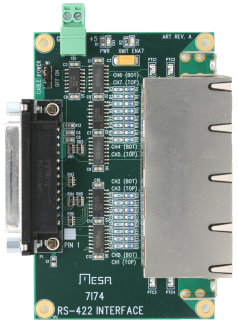 independent
receive and transmit channels. One transmit channel has a independent
drive enable for bus or 2 wire half duplex systems. Serial
I/O connectors are RJ45 jacks allowing standard CAT5
cables to be used for high speed serial links. The 7I74
also supplies 5V power on the RJ 45 connectors. PTC
devices limit maximum 5V current to 1A . The pinout used is compatible
with Mesa's 3C20 motion controller and the 8I20, 8I21 serially
connected amplifiers and all serial interfaced I/O cards.
independent
receive and transmit channels. One transmit channel has a independent
drive enable for bus or 2 wire half duplex systems. Serial
I/O connectors are RJ45 jacks allowing standard CAT5
cables to be used for high speed serial links. The 7I74
also supplies 5V power on the RJ 45 connectors. PTC
devices limit maximum 5V current to 1A . The pinout used is compatible
with Mesa's 3C20 motion controller and the 8I20, 8I21 serially
connected amplifiers and all serial interfaced I/O cards.
7I74
MANUAL
7I75 Breakout/FPGA
protection card
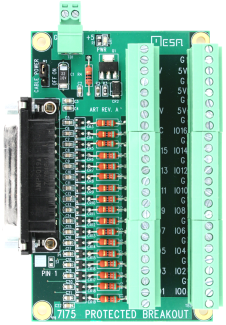 The 7I75 is a breakout card for Mesa's 25 pin I/O FPGA cards. In
addition to providing a breakout function, the 7I75 protects the FPGA
card from excessive input voltages and ESD. The 7I75 protects FPGA I/O
from accidental contact from external voltages of +12 and -5V with
built in diode clamps and 50 Ohm current limit resistors in series with
all I/O pins. The 7I75 limits I/O pin bandwidth to approximately 10 MHz.
Phoenix compatible 3.5 mm pluggable screw terminals are supplied with
the 7I75
The 7I75 is a breakout card for Mesa's 25 pin I/O FPGA cards. In
addition to providing a breakout function, the 7I75 protects the FPGA
card from excessive input voltages and ESD. The 7I75 protects FPGA I/O
from accidental contact from external voltages of +12 and -5V with
built in diode clamps and 50 Ohm current limit resistors in series with
all I/O pins. The 7I75 limits I/O pin bandwidth to approximately 10 MHz.
Phoenix compatible 3.5 mm pluggable screw terminals are supplied with
the 7I75
7I75
MANUAL
7I76 STEP/IO Step&dir plus I/O
daughtercard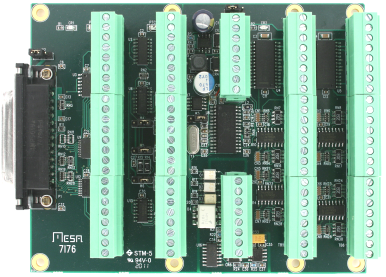
The 7I76 is daughtercard/breakout board for use
with MESA's 25 pin I/O FPGA cards like the 5I25. The 7I76 is designed
for interfacing up to 5 Axis of step &dir step motor or servo
motor drives and also provides a spindle encoder interface, isolated
analog spindle speed control and 48 isolated I/O points for general
purpose field I/O use. All step and direction outputs are buffered 5V
signals that can drive 24 mA. All outputs support
differential mode to reduce susceptibility to noise. An
isolated analog spindle voltage with direction and enable outputs is
provided for spindle control as is a single spindle encoder channel
with TTL or differential inputs. 48 points of isolated field I/O are
provided for general control use including limit switch and control
panel inputs, coolant enable and tool changer control outputs.
Isolated I/O includes 32 sinking inputs and 16 sourcing outputs. Inputs
can sense 5V to 32V signals and the outputs can switch 5V through 28V
signals. Maximum output load is 300 mA.
Outputs are short circuit protected. In
addition to the being able to read digital on/off status of each
input, four input pin voltages are readable with 8 bit
resolution, and two MPG encoder inputs are provided as an option
on four field inputs.
Field I/O is powered by an
isolated 10-32V field power source. One
RS-422 interface is provided for I/O expansion via a serial I/O
daughtercard. All field wiring is terminated in pluggable 3.5 mm
screw terminal blocks.
7I76
MANUAL
7I77 Analog servo interface plus I/O
daughtercard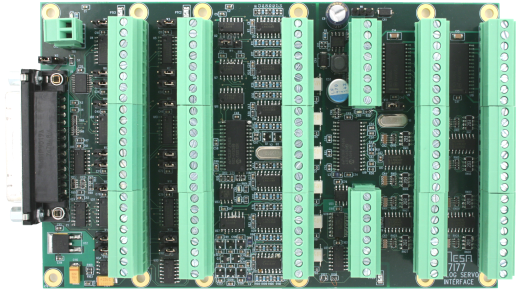
The 7I77 is daughtercard/breakout board for use
with MESA's 25 pin I/O FPGA cards like the 5I25. The 7I77 is designed
for interfacing up to 6 Axis of analog servo
motor drives and also provides 48 isolated I/O points for general
purpose field I/O use. Six +-10V analog outputs and six encoder inputs
(all with index) are provided for servo interfacing. Six floating drive
enable outputs allow control of active high or active low drive
enables. Encoder inputs can be individually set for differential
or single ended mode. 48 points of isolated field I/O are
provided for general control use including limit switch and control
panel inputs, coolant enable and tool changer control outputs.
Isolated I/O includes 32 sinking inputs and 16 sourcing outputs. Inputs
can sense 5V to 32V signals and the outputs can switch 5V through 28V
signals. Maximum output load is 300 mA.
Outputs are short circuit protected. In addition to the
being able to read digital on/off status of each
input, four input pin voltages are readable with 8 bit
resolution,
and two MPG encoder inputs are provided as an option on
four field
inputs. Field I/O is powered by an
isolated 10-32V field power source. One
RS-422 interface is provided for I/O expansion via a serial I/O
daughtercard. All field wiring is terminated in pluggable 3.5 mm
screw terminal blocks.
7I77
MANUAL
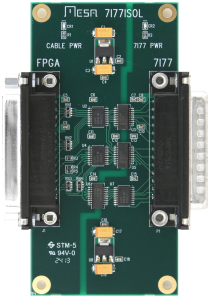
7I77ISOL 7I77 galvanic isolator
The 7I77ISOL is galvanic isolation card that electrically
isolates and rebuffers signals from the FPGA controller card. The
7I77ISOL is useful in cases where severe electrical noise or ground loop problems exist or where longer cable runs are used between the FPGA card and the 7I77.
7I77ISOL
MANUAL
7I78 Step&dir daughtercard
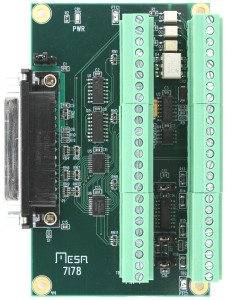 The 7I78 daughtercard/breakout board for
use
with MESA's 25 pin I/O FPGA cards like the 5I25. The
7I78 is designed
for interfacing up to 4 Axis of step &dir step motor or servo
motor drives and also provides a spindle encoder interface,
and an isolated analog spindle control. All step and direction outputs
are buffered 5V
signals that can drive 24 mA. All outputs support
differential mode to reduce susceptibility to noise.
One
RS-422 interface is provided for I/O expansion via a serial I/O
daughtercard. All field wiring is terminated in pluggable 3.5 mm
screw terminal blocks.
The 7I78 daughtercard/breakout board for
use
with MESA's 25 pin I/O FPGA cards like the 5I25. The
7I78 is designed
for interfacing up to 4 Axis of step &dir step motor or servo
motor drives and also provides a spindle encoder interface,
and an isolated analog spindle control. All step and direction outputs
are buffered 5V
signals that can drive 24 mA. All outputs support
differential mode to reduce susceptibility to noise.
One
RS-422 interface is provided for I/O expansion via a serial I/O
daughtercard. All field wiring is terminated in pluggable 3.5 mm
screw terminal blocks.
7I78
MANUAL
7I85 4 Channel encoder 5 channel
Serial RS-422
interface
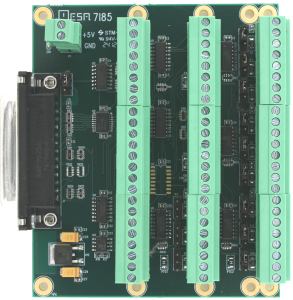 The
7I85 is a five channel
RS-422 serial plus four channel encoder interface for Mesas Anything
I/O
series of FPGA interface cards. The 7I85 is designed for motion control
applications. A common usage of the 7I85 would be connecting up to four
serially interfaced drives to four of the 7I85s five full duplex RS-422
interfaces and up to four encoders with index to the 7I85s
encoder inputs. Encoder inputs can be TTL or differential
on a per input basis. The 7I85 can also supply 5V
power to encoders. A 7I85S version is available that
replaces four of the serial interfaces with 8 differential ouputs that
can
be used as four differential step+ dir output pairs or PWM
outputs
or other output functions. The
controller connection is a DB25 connector that matches the pinout of
Mesa's 25 pin Anything
I/O cards. All buffered I/O is terminated with 3.5 mm pluggable
screw terminals (supplied)
The
7I85 is a five channel
RS-422 serial plus four channel encoder interface for Mesas Anything
I/O
series of FPGA interface cards. The 7I85 is designed for motion control
applications. A common usage of the 7I85 would be connecting up to four
serially interfaced drives to four of the 7I85s five full duplex RS-422
interfaces and up to four encoders with index to the 7I85s
encoder inputs. Encoder inputs can be TTL or differential
on a per input basis. The 7I85 can also supply 5V
power to encoders. A 7I85S version is available that
replaces four of the serial interfaces with 8 differential ouputs that
can
be used as four differential step+ dir output pairs or PWM
outputs
or other output functions. The
controller connection is a DB25 connector that matches the pinout of
Mesa's 25 pin Anything
I/O cards. All buffered I/O is terminated with 3.5 mm pluggable
screw terminals (supplied)
7I85
MANUAL 7I85S
MANUAL
7I89 8 channel encoder plus RS-422/RS-485 interface
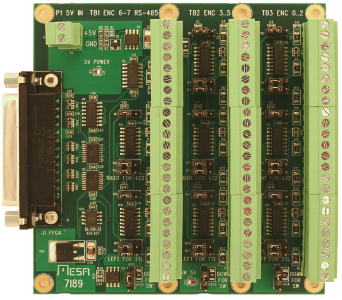 The
7I89 is a 8 channel encoder interface for Mesas Anything
I/O
series of FPGA interface cards. The 7I89 is designed for motion control
applications. A Encoder inputs can be TTL or differential
on a per input basis. The 7I89 can also supply 5V
power to encoders.
5V encoder power can be optionally switched to allow reset of combined
absolute/incremental encoders. In addition to the 8 encoder
inputs, a single RS-422/RS-485 interface is provided. This interface is
compatible with Mesa's sserial I/O expansion cards. The
controller connection is a DB25 connector that matches the pinout of
Mesa's 25 pin Anything
I/O cards. All buffered I/O is terminated with 3.5 mm pluggable
screw terminals (supplied)
The
7I89 is a 8 channel encoder interface for Mesas Anything
I/O
series of FPGA interface cards. The 7I89 is designed for motion control
applications. A Encoder inputs can be TTL or differential
on a per input basis. The 7I89 can also supply 5V
power to encoders.
5V encoder power can be optionally switched to allow reset of combined
absolute/incremental encoders. In addition to the 8 encoder
inputs, a single RS-422/RS-485 interface is provided. This interface is
compatible with Mesa's sserial I/O expansion cards. The
controller connection is a DB25 connector that matches the pinout of
Mesa's 25 pin Anything
I/O cards. All buffered I/O is terminated with 3.5 mm pluggable
screw terminals (supplied)
7I89
MANUAL
7I88 16 Channel differential driver
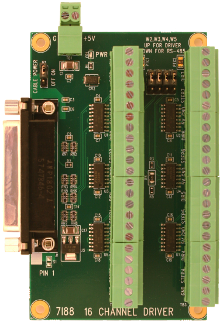 The
7I88 is a 16 channel differential driver that can provide up to 8
differential Step/Dir or 8 PWM/Dir output channels. The last
channel pair can be be used as a RS-485 interface if desired. All
differential outputs have a full 5V swing and can be used single ended
if required. 5V and GND conections are provided for all channels. The
controller connection is a DB25 connector that matches the pinout of
Mesa's 25 pin Anything
I/O cards. All buffered I/O is terminated with 3.5 mm pluggable
screw terminals (supplied)
The
7I88 is a 16 channel differential driver that can provide up to 8
differential Step/Dir or 8 PWM/Dir output channels. The last
channel pair can be be used as a RS-485 interface if desired. All
differential outputs have a full 5V swing and can be used single ended
if required. 5V and GND conections are provided for all channels. The
controller connection is a DB25 connector that matches the pinout of
Mesa's 25 pin Anything
I/O cards. All buffered I/O is terminated with 3.5 mm pluggable
screw terminals (supplied)
7I88
MANUAL
MISC
DAUGHTERCARDS
Daughtercards with other interfaces
THCAD
High isolation A-D accessory
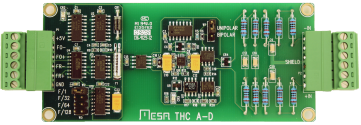 The THCAD is a
frequency to voltage converter type A-D designed for high
noise environments like plasma voltage monitoring for torch
height controls.
The THCAD is available in three voltage
ranges, 0-5V, 0-10V and 0-300V. When used for plasma voltage
monitoring, the 5V and 10V versions require an external high voltage
resistor. The advantage of the 5V and 10V THCAD and external resistor is that
the resistor can be selected to work with high-frequency start
torches.
The 300V version of the THCAD has all input divider resistor on board
and can connect directly to the plasma voltage of touch start type
torches only. The THCAD has a frequency output range of approximately
100 KHz to 1 MHz. This can be counted directly by our FPGA cards for
conversion to voltage value. The
frequency output can optionally be divided by 32, 64 or 128 if the
output must be counted in software. Frequency and reference frequency
outputs are available. Both outputs are differential for high noise
immunity. The A-D has galvanically isolated inputs (2500V common
mode isolation). The 5V and 10V model can withstand a 500V input
overload indefinately. The 300V model can withstand a 2500V input
overload indefinately. Being a frequency to voltage type A-D,
resolution is sample rate dependent and approximately 10 bits at a 1
KHz sample rate and 12 bits at a 250 Hz sample rate. The THCAD is
normally used in unipolar mode but can be jumpered for bipolar mode for
non-plasma applications. The THCAD requires 5V at 150 mA for
operation. Pluggable screw terminal blocks are provided for all
connections.
The THCAD is a
frequency to voltage converter type A-D designed for high
noise environments like plasma voltage monitoring for torch
height controls.
The THCAD is available in three voltage
ranges, 0-5V, 0-10V and 0-300V. When used for plasma voltage
monitoring, the 5V and 10V versions require an external high voltage
resistor. The advantage of the 5V and 10V THCAD and external resistor is that
the resistor can be selected to work with high-frequency start
torches.
The 300V version of the THCAD has all input divider resistor on board
and can connect directly to the plasma voltage of touch start type
torches only. The THCAD has a frequency output range of approximately
100 KHz to 1 MHz. This can be counted directly by our FPGA cards for
conversion to voltage value. The
frequency output can optionally be divided by 32, 64 or 128 if the
output must be counted in software. Frequency and reference frequency
outputs are available. Both outputs are differential for high noise
immunity. The A-D has galvanically isolated inputs (2500V common
mode isolation). The 5V and 10V model can withstand a 500V input
overload indefinately. The 300V model can withstand a 2500V input
overload indefinately. Being a frequency to voltage type A-D,
resolution is sample rate dependent and approximately 10 bits at a 1
KHz sample rate and 12 bits at a 250 Hz sample rate. The THCAD is
normally used in unipolar mode but can be jumpered for bipolar mode for
non-plasma applications. The THCAD requires 5V at 150 mA for
operation. Pluggable screw terminal blocks are provided for all
connections.
THCAD
MANUAL
THCAD2
High isolation A-D accessory
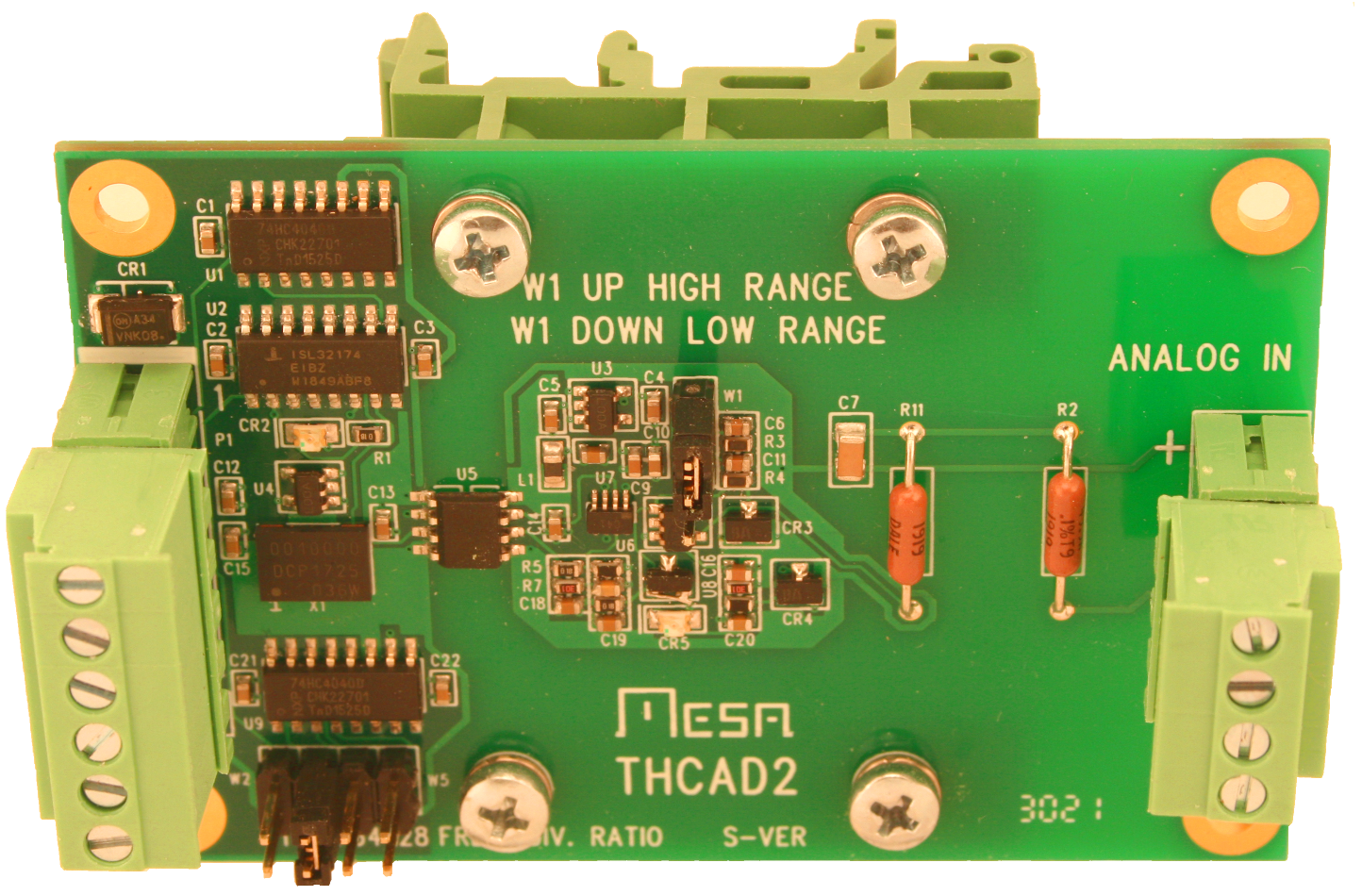 The
THCAD2 is a frequency to voltage converter type A-D designed for high
noise environments like plasma voltage monitoring for torch height
controls. The THCAD2 has selectable 0 to 5V and 0 to 10V ranges. When
used for direct plasma voltage monitoring, the THCAD2 requires an
external high voltage resistor.
The
THCAD2 is a frequency to voltage converter type A-D designed for high
noise environments like plasma voltage monitoring for torch height
controls. The THCAD2 has selectable 0 to 5V and 0 to 10V ranges. When
used for direct plasma voltage monitoring, the THCAD2 requires an
external high voltage resistor.
The THCAD2 has a frequency output range of
approximately 100 KHz to 1 MHz. This can be counted directly by our
FPGA cards or uControllers for conversion to digital voltage value. The
frequency output can optionally be divided by 32, 64 or 128 if the
output must be counted in software.
Frequency and reference frequency outputs are
available. Both outputs are differential for high noise immunity, but
can be used single-ended (TTL) if desired. The A-D has
galvanically isolated inputs (2500V common mode isolation). The THCAD2
can withstand a 500V input overload indefinitely.
Being a frequency to voltage type A-D, resolution is
sample rate dependent and approximately 10 bits at a 1 KHz sample rate
and 12 bits at a 250 Hz sample rate. The THCAD2 requires 5V at 150 mA for operation.
Pluggable screw terminal blocks are provided for all connections.
THCAD2
MANUAL
BACK TO HOME PAGE